The Finding: The Postseason Rewards the Home Team More — Not Less
There's a comforting idea that the playoffs are a great equalizer — that once everyone's good, home field stops mattering and anyone can win. The data says the opposite. I pulled the complete nflverse game log bundled with this site — 7,276 played games across the 27 seasons from 1999 through 2025 — and split it into the regular season and each playoff round. Home teams win 56.0% of regular-season games; in the playoffs that jumps to 62.1%, and in the Divisional round it peaks at 69.4%. Overtime gets more common too, and — contrary to the “tight, low-scoring January football” cliche — scoring does not fall.
The Exhibit: Home Win% by Stage
Each bar is the home team's win percentage for that stage, with overtime rate and average combined points annotated. The dashed navy line is the regular-season baseline (56.0%); the dotted line marks the 50% coin flip. The neutral-site Super Bowl is excluded from the home-win comparison — there is no true home team.
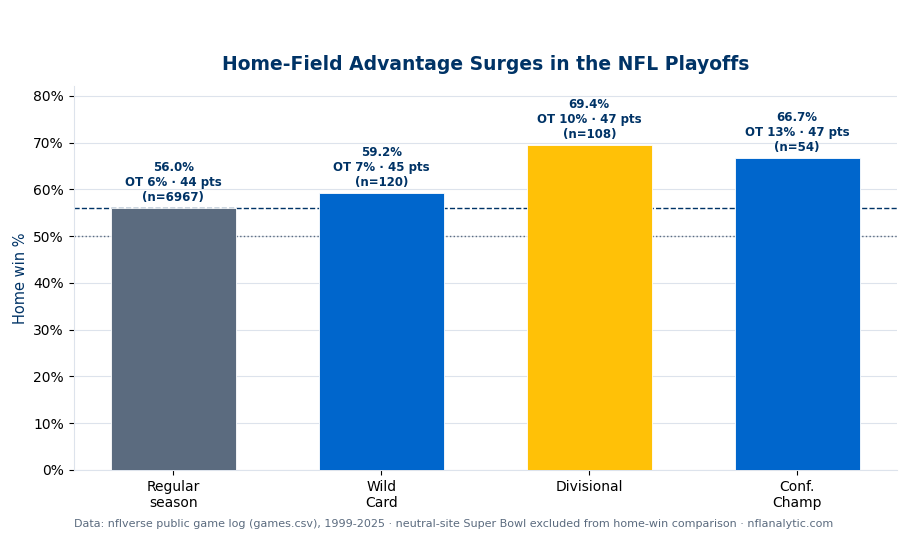
Read it left to right and three things move at once. Home win% climbs every round until the Conference Championship; overtime rate rises from 6.0% in the regular season to 13.0% in Conference Championship games — more than double; and average combined points rises from 44.2 to roughly 47. The postseason is more home-friendly, more likely to need extra time, and slightly higher-scoring than the regular season — the reverse of how it's usually described.
Why the Bracket Manufactures Home Wins
The surge isn't mysterious — it's structural. Seeding hands home games to the best teams against the worst remaining ones, so the home team in a playoff game is, on average, much better than its visitor. That's clearest in the Divisional round: the top seeds sat out wild-card weekend on a bye, then host a team that just played (and traveled) a week earlier. A rested, higher-seeded, home team against a tired, lower-seeded, traveling one is the most lopsided setup in the sport — and the 69.4% home win rate is the result.
The mechanism in one line
Regular-season home advantage is mostly about the venue. Playoff home advantage stacks the venue on top of seeding (the host is the better team) and rest (byes and short weeks) — three edges pointing the same way.
It also explains the dip from the Divisional round (69.4%) to the Conference Championship (66.7%): by the final four, the seeding gap between the remaining teams has narrowed, so the host's built-in advantage shrinks a little even though it's still large. The more evenly matched the teams, the smaller the slice that home field can add.
More Overtime, Not Lower Scoring
Two popular beliefs about playoff football get tested here, and they split. The “more overtime” belief holds up emphatically — OT is far more common once the games are win-or-go-home and the teams are closely matched, climbing to 13% of Conference Championship games. But the “low-scoring, conservative January football” belief does not: average combined points are actually higher in the playoffs (about 47) than the regular season (44.2). Better offenses survive to January, and the games that go long pad the points totals. If anything, playoff football is more entertaining by the scoreboard, not less.
Caveats and Limits
The playoff home team is usually the better seed, so this isn't a clean measure of “the venue.” Most of the surge is seeding and rest riding along with home field, not the crowd alone.
There are only 54 Conference Championships and 108 Divisional games in 27 years. The round-by-round figures are real but will wobble; treat the direction as solid and the exact percentages as approximate.
It's excluded from the home-win comparison on purpose — the “home” designation is administrative, so its result says nothing about home-field advantage.
The field expanded to 14 teams in 2020 (one bye per conference instead of two), which subtly changed Divisional-round rest dynamics across the 27-season span.
The bottom line
Across 1999–2025, NFL home teams won 62.1% of playoff games versus 56.0% in the regular season, peaking at 69.4% in the Divisional round, while overtime roughly doubled and scoring edged up rather than down. The postseason doesn't neutralize home field — it amplifies it, because the bracket is designed to reward the better seed with a home game against a tired, lesser opponent. The equalizer narrative is backwards: January is when home field matters most.
Further reading
- Chapter 25: Home Field Advantage Deep Dive — the full treatment, at DataField.dev.
- Home-Field Advantage, Measured — the 27-season regular-season trend
- Division Games and Home Field — how familiarity shrinks the home edge
- Rest and Scheduling — the bye-week and short-week effects that feed the Divisional round
- Pro-Football-Reference — playoff results and seeding for every season
Go deeper
Want the code behind these metrics? Work through the 45-chapter NFL analytics tutorial.
Browse tutorials Free tools