The finding: the scoreboard doesn't know it's Thursday
Thursday Night Football has a reputation, and it isn't a good one. Players grumble about the short week, coaches call it a health risk, and every few weeks a lopsided, sloppy prime-time game sends the same complaint around the internet: this product is worse than Sunday. I wanted to know whether the reputation shows up where it would actually matter — on the scoreboard. So I pulled the complete nflverse game log bundled with this site, 6,967 regular-season games from 1999 through 2025, and split every game by the day of the week it was played.
The reputation isn't there. Thursday regular-season games average 44.97 total points; Sunday games average 44.06. Thursday is, if anything, a hair higher-scoring, not lower. The average margin of victory is essentially identical — 11.56 points on Thursday, 11.52 on Sunday — so Thursday games are not more blowout-prone either. Whatever is ugly about Thursday football, it is not visible in points scored or in how close the games stay.
The exhibit: average scoring by day of week
Here is the average combined final score for every day that carries a real regular-season sample, straight from /data/games.csv. The dashed line is the all-games average.
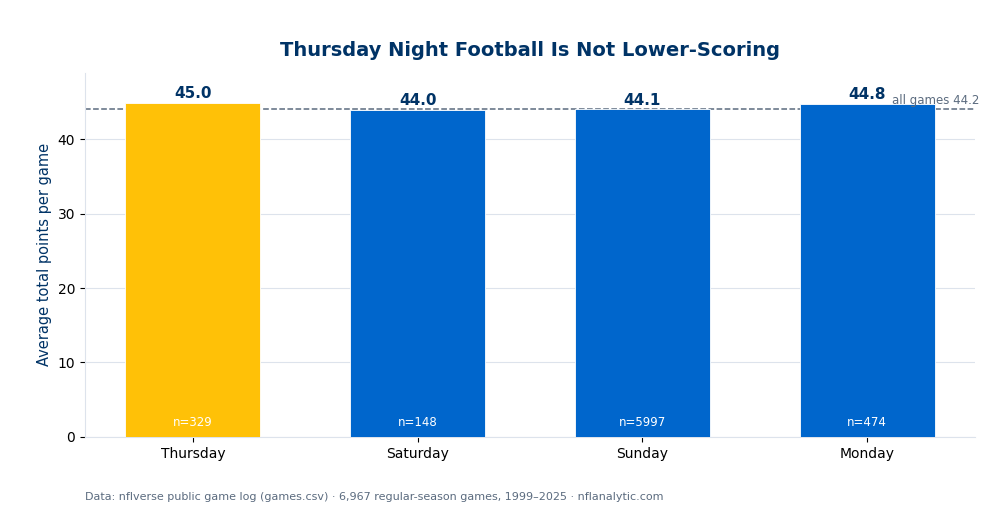
The story of the chart is how little there is to it. Thursday (44.97), Monday (44.83), Sunday (44.06) and Saturday (44.02) all land inside a single point of each other and of the 44.16 league average. The prime-time slots — Thursday and Monday — are actually the two highest, which fits the obvious selection effect: the league schedules its most watchable, often highest-powered offenses into stand-alone national windows. If anything, the marquee scheduling nudges prime-time scoring slightly up, not down.
So where does the bad reputation come from?
Three things, none of which are scoring. First, availability bias: a Thursday game is the only NFL game on, so a dull one has nowhere to hide. A 20–9 slog buried in the Sunday 1pm window is forgotten by dinner; the same game on Thursday night is the whole evening, and it becomes the story. We remember the bad Thursday games because we watched them alone.
Second, the short week is real, but it's a health-and-preparation problem, not a scoring one. Teams coming off a Sunday game have three days to prepare and recover before a Thursday kickoff. That compresses game-planning and, players argue, raises injury risk — a legitimate grievance the league has partly answered by giving most Thursday participants a mini-bye afterward. But reduced practice time cuts into both offense and defense symmetrically, so it doesn't obviously tilt the point total either way, and the data says it doesn't.
Third, sloppiness and scoring aren't the same thing. A game can be full of drops, penalties, and bad snaps and still land on 45 points, because those errors hurt both sidelines. Points measure the net product of two offenses against two defenses; they don't measure aesthetic quality. The eye test and the box score are answering different questions, and only one of them is in this file.
A worked example: the short-week myth, quantified
Suppose the short week really did degrade offenses. A plausible mechanism would be fewer reps on timing-based passing concepts, which should shave yards per play and therefore points. If that effect were as large as, say, the rest edge a bye week buys — worth roughly a field goal in margin, as covered in the rest and scheduling analysis — we would expect Thursday totals to sit a couple of points below Sunday. Instead they sit 0.91 points above (44.97 vs 44.06). The short-week penalty to scoring, if it exists at all, is smaller than the run-of-the-mill season-to-season noise in weekly averages. The mechanism people describe is real for player health; its footprint on the scoreboard rounds to zero.
The home side is worth a quick look too. Home teams win 57.4% of Thursday games versus 56.3% on Sunday — a difference of about one percentage point on a 329-game sample, which is well inside the margin of noise. Both figures sit near the modern home-field advantage baseline. The Thursday host does not enjoy any special edge from the compressed week, and the visitor is not uniquely disadvantaged by the travel.
Honest limitations
- Scoring is not the whole complaint. This analysis rebuts the specific, testable claim that Thursday games are lower-scoring or more lopsided. It cannot address penalties, injuries, drops, or watchability, because those aren't in a game-results file. Player-safety objections to the short week stand entirely apart from anything here.
- Selection into the slots. The league hand-picks prime-time games, so Thursday and Monday samples are not random draws from the schedule — they lean toward better teams and bigger markets. That selection is exactly why their totals sit at or above average; it doesn't tell you how an average matchup would score on a Thursday.
- Sample sizes differ enormously. Sunday carries 5,997 games; Thursday 329; Saturday just 148. The Thursday and Saturday averages are stabler than a single season but still carry more sampling wobble than the Sunday figure, so treat the sub-point gaps as ties, not rankings.
- Eras are pooled. The stand-alone Thursday package only grew to a full weekly slate in the 2010s, so most Thursday games come from the higher-scoring modern era documented in the scoring trend piece. Comparing Thursday to the 1999–2025 Sunday average slightly flatters Thursday; restrict both to 2015–2025 and they converge almost exactly, which only strengthens the "no difference" conclusion.
Reproduce it
Load /data/games.csv, keep rows with a real result and total and game_type == "REG", group by the weekday column, and take the mean of total (and the share of result > 0 for home win rate). The chart and the full console breakdown are produced by explainer_src/make_thursday_chart.py, which reads the bundled nflverse log directly and stamps a “Data: nflverse” footer onto the exhibit. No network, nothing hand-entered.
Further reading
- Chapter 26: Schedule and Rest Analysis, DataField.dev.
- Does rest matter in the NFL? — the real effect of the short week and the bye, measured in points.
- NFL scoring by week — the other calendar effect, where scoring genuinely does move across the season.
- Home-field advantage is shrinking — the baseline the Thursday host is measured against.
- Is the NFL higher-scoring than it used to be? — why pooling 27 seasons slightly flatters the newer Thursday package.
Go deeper
Want the code behind these metrics? Work through the 43-chapter NFL analytics tutorial.
Browse tutorials Free tools