Nobody Keeps This Crown
Since the 2002 realignment the NFC West has crowned a champion 24 times, and the crown will not sit still. Seattle owns 10 of the titles, San Francisco 6, the Rams 5 (the 2003 St. Louis title folds onto the franchise's row), and Arizona 3 — every member has won it at least three times, and none has held it longer than Seattle's four straight, 2004–07. The last three seasons sharpen the point: San Francisco in 2023, the Rams in 2024, Seattle in 2025 — three different champions in three years, the only division in the league for which that is currently true. Every other division's last three titles involve exactly two clubs.
That's the frame for a 2026 preview that states no predictions of its own: this is the division where holding serve is the exception. The forecasting lives at the predictions page, built on the site's prediction model.
The Exhibit: The Crown Strip, 2002–2025
Derive every season's champion from the game file itself — win percentage, then the official NFL tiebreaker chain — and plot who held the crown each year, beside a context panel counting how often each division's title moved:
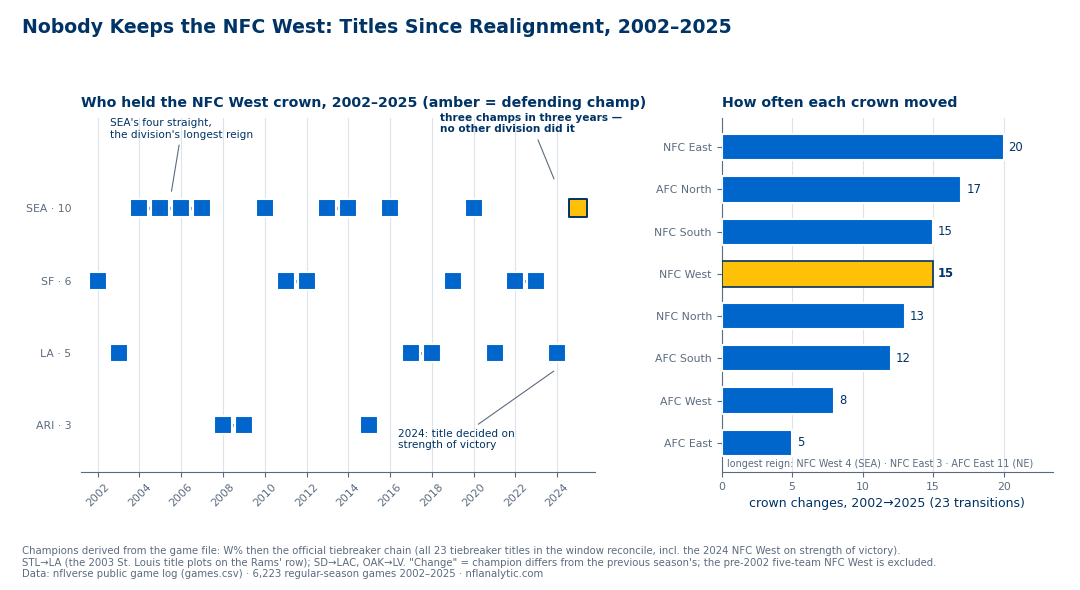
The longest unbroken run on the strip is four squares. Since 2019 it goes San Francisco, Seattle, Rams, San Francisco, San Francisco, Rams, Seattle — the crown moved in 5 of the last 6 transitions, the lone repeat being San Francisco's 2022–23 pair. The window even opened this way: San Francisco 2002, the St. Louis Rams 2003, Seattle 2004.
Churn in Context: 15 Changes, No Dynasty
The context panel keeps this from being a just-so story. Across the 23 transitions since 2002, the NFC West's champion changed 15 times (65.2%) — level with the NFC South, behind only the NFC East's 20 and the AFC North's 17, and far from the AFC East (5) and AFC West (8), each a one-team property for a decade-plus. But the West's churn has a distinctive shape: the AFC North's 17 changes come with a longest reign of just two — pure alternation — and the NFC East's 20 cap out at a three-peat, while the West pairs its 15 changes with a four-year reign and three two-peats (Arizona 2008–09, San Francisco 2011–12, the Rams 2017–18). It cycles, but in eras.
The round-robin ledger explains the title split almost exactly. In the division's 288 intra-division games since 2002, Seattle went 86-57-1 (.601), San Francisco 75-68-1 (.524), the Rams 66-77-1 (.462), and Arizona 59-84-1 (.413) — the same order as the title count, at roughly the same spacing. Nor are the games close: the Cardinals–Rams series' 14.58-point average margin over 48 meetings is the widest of any division rivalry pair in the league — why familiarity compresses some division games and not others is the division-games page's territory.
2025: A Clean Handover, For Once
The 2024 title needed the deepest tiebreak the window has ever recorded — the Rams over Seattle on strength of victory. That decision and the full tiebreaker machinery belong to the division-repeats page; this page's standings derivation imports that page's exact code path, so the two can never disagree on a champion, and all 23 tiebreaker-decided titles reconcile against the official record, 2024 included.
2025 required no such machinery. Seattle finished 14-3 with a +191 point differential (483 scored, 292 allowed), two games clear of the Rams (12-5, +172) and San Francisco (12-5, +66); Arizona cratered at 3-14, −133. Inside the division the file shows something stranger: Seattle, the Rams, and San Francisco each went 4-2, splitting all three series between them, while Arizona went 0-6, outscored 208-116. The division sorted itself entirely on the other eleven games — the kind of outcome that keeps this crown moving.
The 2026 Round-Robin on the Calendar
The 2026 rows are unplayed — no result here touches them — but the calendar facts are set:
- The round-robin opens at a cricket ground. San Francisco–Rams, Thursday night of week 1, at the Melbourne Cricket Ground — one of only two neutral-site division games on the 2026 schedule (Houston–Jacksonville, week 15, is the other). The pairing's 54-game ledger is worked at the week-1 slate page; the Melbourne calendar mechanics — and Seattle's Wednesday-night season opener the day before — live at the schedule-quirks page.
- A Christmas night game, and zero Sunday nights. The Rams visit Seattle on Friday, December 25, 8:15 PM ET — the round-robin's only night game besides Melbourne. The other ten are Sunday-afternoon kickoffs: eight in the 4-o'clock windows through week 14, then both week-18 closers at 1:00.
- It's evenly spread, and it ends in a doubleheader. Six of the twelve games land in weeks 1–9, six after. The season closes January 10 with San Francisco at Arizona and Seattle at the Rams. Byes: San Francisco week 8, the Rams and Seattle both week 11, Arizona week 14.
Whose full slate is hardest on paper is the schedule-strength page's question; win totals belong to the predictions page. This page's claim is narrower: a crown that moved 15 times in 23 chances, three champions in the last three years, and a 2025 in which the top three split every series describe a division with no incumbent advantage to preview.
Honest Limitations
- Churn is description, not destiny. 15 changes in 23 transitions is a base rate about the past, not a 2026 probability — the league-wide repeat evidence, properly framed, lives at the division-repeats page, and this page states none of its own.
- Titles are thin labels. The strip compresses each season to one square: the 2010 champion went 7-9, the 2025 champion 14-3, and both plot identically. Nothing here measures how good any champion was.
- Franchise continuity is a convention. STL→LA (and SD→LAC, OAK→LV elsewhere in the file) puts the 2003 St. Louis title on the Rams' row. The rows are franchises, not cities.
- The window is a choice. Realignment made the eight divisions like-for-like four-team units in 2002; the earlier five-team NFC West is excluded, and Seattle only joined in 2002.
- The 2026 rows are unplayed and the schedule can move. Every 2026 item above is a calendar fact from the file as pulled; kickoff times get flexed. Rerunning the script regenerates every number here.
Reproduce It
One public file: games.csv from nflverse nfldata, bundled at /data/games.csv. The chart and full console breakdown come from explainer_src/make_nfc_west_preview_chart.py, which imports the standings-and-tiebreaker derivation from the division-repeats script rather than reimplementing it. The core:
import pandas as pd
import make_division_repeat_chart as mdrc   # shared standings + official tiebreaker chain

games, n = mdrc.load_games()                # 6,223 REG games, 2002-2025
winners, *_ = mdrc.standings(games)         # reconciles all 23 tiebreaker titles

seq = [winners[(s, "NFC West")] for s in range(2002, 2026)]
print({t: seq.count(t) for t in ("SEA", "SF", "LA", "ARI")})
# {'SEA': 10, 'SF': 6, 'LA': 5, 'ARI': 3}
print(sum(a != b for a, b in zip(seq, seq[1:])), seq[-3:])
# 15 crown changes of 23   ['SF', 'LA', 'SEA']

df = pd.read_csv("https://nflanalytic.com/data/games.csv")
df[["home_team", "away_team"]] = df[["home_team", "away_team"]].replace(
    {"SD": "LAC", "STL": "LA", "OAK": "LV"})
reg = df[(df.game_type == "REG") & df.home_score.notna()
         & df.season.between(2002, 2025)]
WEST = ["ARI", "LA", "SEA", "SF"]
dw = reg[(reg.div_game == 1) & reg.home_team.isin(WEST)
         & reg.away_team.isin(WEST)]        # 288 round-robin games
for t in WEST:
    m = (dw.home_team == t) | (dw.away_team == t)
    w = (((dw.home_team == t) & (dw.result > 0)) |
         ((dw.away_team == t) & (dw.result < 0))).sum()
    tie = (m & (dw.result == 0)).sum()
    print(t, f"{w}-{m.sum() - w - tie}-{tie}")
# ARI 59-84-1  LA 66-77-1  SEA 86-57-1  SF 75-68-1
All figures on this page were computed 2026-08-12 from the file's played games — 6,223 regular-season games 2002–2025, including the 288 NFC West round-robin games — plus the 2026 schedule rows for calendar facts only. Nothing is hand-entered; no 2026 result is quoted because none exists.
Data: nflverse/nfldata, public. Champions are derived from the game file (win percentage, then the official tiebreaker chain with the multi-club restart rule); relocated franchises fold into current codes (STL→LA, SD→LAC, OAK→LV).
Further Reading
- Do division champions repeat? — the league-wide repeat rate, the tiebreaker chain this page's standings are built on, and the 2024 strength-of-victory decision in full.
- The 2026 week-1 slate — all sixteen openers, including the Melbourne game's 54-meeting ledger.
- Reading the 2026 schedule — the Wednesday–Melbourne calendar mechanics, rest ledgers, and the bye map.
- The team pages: Arizona Cardinals, Los Angeles Rams, Seattle Seahawks, San Francisco 49ers.
- Around the conference: NFC East 2026, NFC North 2026, NFC South 2026.
Go deeper
Want the code behind these metrics? Work through the 43-chapter NFL analytics tutorial.
Browse tutorials Free tools