How do NFL tiebreakers work?
When teams finish with the same record, the NFL works down a fixed list until one club is ahead. For two teams in the same division the list starts with head-to-head, then division record, common games, conference record, strength of victory and strength of schedule, and ends with points rankings, net points, net touchdowns and a coin toss. Teams from different divisions chasing a wild card use a shorter list that skips division record and moves conference record up to second. In practice the early steps do the work: from 2002 to 2025, 23 of 192 division titles went to a tiebreaker, and head-to-head or division record settled 18 of them.
Related: 2026 standings · The playoff picture after week 5 · Try it: the NFL Playoff Picker
Procedure as published by the NFL, read on October 17, 2026. History computed from every regular-season score 2002-2025; 2026 examples use the 80 games played through Thursday of week 6.
Two Lists, Not One
The NFL publishes two tie-breaking procedures. The first ranks teams inside a division, which decides division titles. The second ranks teams from different divisions, which decides the wild cards and the order of the seeds. The league uses it for division winners too: its rule text says home-field priority among division winners is set by the wild-card tiebreakers. Everything starts from won-lost-tied percentage, and a tie game counts as one-half win and one-half loss for both clubs.
| Step | Same division (two clubs) | Different divisions, wild card (two clubs) |
|---|---|---|
| 1 | Head-to-head | Head-to-head, if they played |
| 2 | Record in division games | Record in conference games |
| 3 | Record in common games | Record in common games, minimum of four |
| 4 | Record in conference games | Strength of victory |
| 5 | Strength of victory | Strength of schedule |
| 6 | Strength of schedule | Combined ranking in points scored and allowed, conference teams |
| 7 | Combined ranking in points scored and allowed, conference teams | Combined ranking, all teams |
| 8 | Combined ranking, all teams | Net points in conference games |
| 9 | Net points in common games | Net points in all games |
| 10 | Net points in all games | Net touchdowns in all games |
| 11 | Net touchdowns in all games | Coin toss |
| 12 | Coin toss |
Strength of victory is the combined winning percentage of the teams a club beat; strength of schedule is the same figure for every opponent it played. Common games are the games each tied club played against the same opponents, compared by winning percentage because the counts can differ. The combined ranking adds a team's rank in points scored to its rank in points allowed, and the lower total wins. The NFL's own example: a team first in scoring and second in points allowed has a combined ranking of 3.
The Rules Inside the Rules
The step lists are the easy part. Most of the confusion comes from four rules that sit around them.
- One club at a time. "Only one club advances to the playoffs in any tie-breaking step." When a step picks a winner, everyone left goes back to step 1, and when a step knocks out one club of three, the remaining two restart at step 1 of the two-club list. That is why a three-way tie can be settled by two different steps.
- Division first, then the wild card. When three or more clubs tie for a wild card, the NFL first applies the division tiebreaker to remove all but the highest-ranked club from each division. Only then do the wild-card steps run. A team can lose a wild card it would have won on conference record because a division rival beat it first.
- Head-to-head means a sweep with three or more. In the wild-card list for three or more clubs, head-to-head applies only if one club beat every other club, or lost to every other club. A 1-0 record against one rival is not enough if it has not played the third.
- The minimum of four. Common games count in the wild-card list only when there are at least four of them. In the division list there is no minimum, since division rivals share most of their schedule.
The published text is not perfectly tidy. One note in the three-club wild-card section still refers to "the two Wild-Card participants", although the same page opens that section with "the three Wild-Card clubs" from each conference, the format since 2020.
The Exhibit
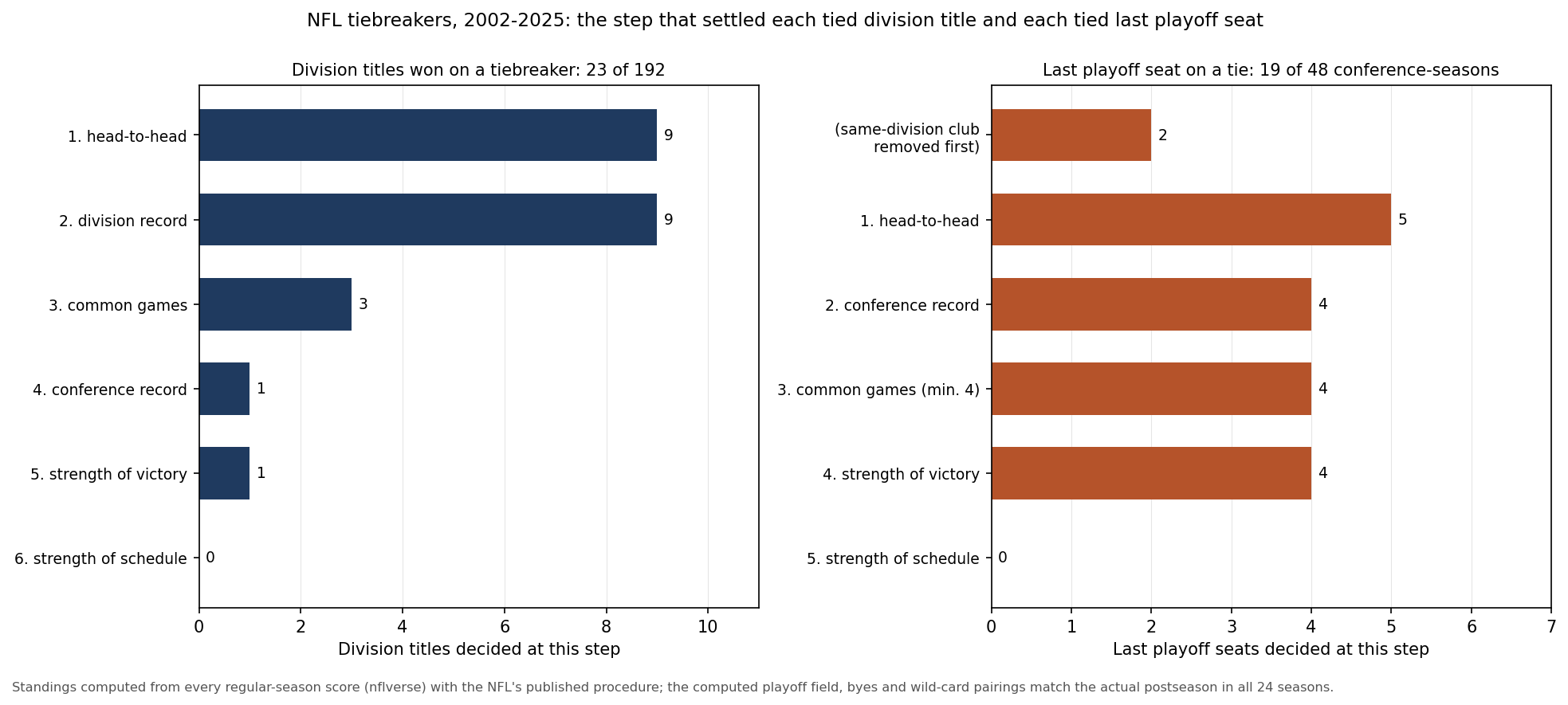
Which Steps Actually Decide Ties
Twelve steps look like a lot of machinery. Since the league split into eight divisions in 2002, almost all of it has sat idle.
Division titles. In 24 seasons, 23 of 192 division titles went to a team tied with at least one rival. Head-to-head settled nine and division record nine, so the first two steps decided 18 of the 23. Common games settled three, conference record one, and strength of victory one: the 2024 NFC West, where the Rams finished level with Seattle. Three of the 23 involved three clubs (the 2002 AFC East, the 2011 AFC West and the 2025 NFC South).
The last playoff seat. In 19 of 48 conference-seasons, the last team into the playoffs finished on the same record as at least one team left out. That happened in 17 of the 24 seasons; only 2005, 2013, 2014, 2018, 2019, 2024 and 2025 had no such tie. Head-to-head settled five of the 19, conference record four, common games four and strength of victory four. In the other two, the team left out was removed before the wild-card steps began, by the division tiebreaker against a rival on the same record.
What never happened. Strength of schedule, the sixth division step and fifth wild-card step, did not decide a single title or last seat in the 24 seasons. Neither did the points rankings, net points, net touchdowns or the coin toss.
| Season | Conf. | Last seat | Same record, left out | Deciding step |
|---|---|---|---|---|
| 2002 | AFC | Cleveland | Denver, Miami, New England | conference record |
| 2003 | AFC | Denver | Miami | conference record |
| 2004 | NFC | Minnesota | New Orleans | head-to-head |
| 2006 | AFC | Kansas City | Denver | division tiebreaker first |
| 2006 | NFC | the Giants | Carolina, Green Bay, St. Louis | strength of victory |
| 2007 | AFC | Tennessee | Cleveland | common games |
| 2008 | AFC | Baltimore | New England | conference record |
| 2009 | AFC | Baltimore | Houston, Pittsburgh | conference record |
| 2010 | NFC | Green Bay | the Giants, Tampa Bay | strength of victory |
| 2011 | AFC | Cincinnati | Tennessee | head-to-head |
| 2012 | NFC | Minnesota | Chicago | division tiebreaker first |
| 2015 | AFC | Pittsburgh | the Jets | common games |
| 2016 | NFC | Detroit | Tampa Bay | common games |
| 2017 | AFC | Buffalo | Baltimore, the Chargers | strength of victory |
| 2020 | NFC | Chicago | Arizona | common games |
| 2021 | NFC | Philadelphia | New Orleans | head-to-head |
| 2022 | AFC | Miami | Pittsburgh | head-to-head |
| 2022 | NFC | Seattle | Detroit | head-to-head |
| 2023 | NFC | Green Bay | New Orleans, Seattle | strength of victory |
Seeds 1-6 per conference through 2019, 1-7 since 2020. The deciding step is the one that put the last-seeded team ahead of the teams it was tied with at that point.
Two Worked Cases From History
2002 AFC: four teams at 9-7 for one seat. Cleveland, Denver, New England and Miami all finished 9-7 behind the Jets, who won the AFC East on a tiebreaker at 9-7 as well. Because New England and Miami share a division, the division tiebreaker ran first: the two split their games, and New England's 4-2 division record beat Miami's 2-4, so Miami was out before the wild-card steps started. That mattered, because Miami's 7-5 conference record equaled Cleveland's. With Miami gone, there was no head-to-head sweep among the three left, and Cleveland's 7-5 conference record beat New England's 6-6 and Denver's 5-7.
2017 AFC: strength of victory at work. Tennessee, Buffalo, Baltimore and the Chargers finished 9-7. Tennessee's 8-4 conference record took the first of those wild cards. For the last one, the Chargers' 6-6 conference record dropped them, leaving Buffalo and Baltimore to restart the two-club list. They had not played each other, both were 7-5 in the conference, and both went 4-1 in their five common games. The fourth step settled it: the teams Buffalo beat had a combined .396 winning percentage, the teams Baltimore beat .299.
2026: If the Season Ended Thursday Night
Through the 80 games played to Thursday of week 6, ending with Denver's 17-14 win over Seattle, here is how the procedure orders each conference. Conf. is the record in conference games, the step that does most of the work below. None of these ties is final: most of the head-to-head games have not been played, and a single Sunday can rearrange the list.
AFC
| Seed | Team | W-L-T | Conf. | Division |
|---|---|---|---|---|
| 1 | Kansas City | 4-0 | 4-0 | AFC West |
| 2 | Baltimore | 4-1 | 2-0 | AFC North |
| 3 | Jacksonville | 4-1 | 3-1 | AFC South |
| 4 | Buffalo | 4-1 | 2-1 | AFC East |
| 5 | Denver | 4-2 | 2-1 | AFC West |
| 6 | New England | 3-2 | 3-1 | AFC East |
| 7 | The Raiders | 3-2 | 2-2 | AFC West |
| 8 | Cleveland | 3-2 | 1-2 | AFC North |
| 9 | Pittsburgh | 3-2 | 2-2 | AFC North |
Seeds 2 to 4: three division leaders at 4-1. Baltimore, Jacksonville and Buffalo have not played one another, so there is no sweep, and the next wild-card step is conference record: Baltimore 2-0, Jacksonville 3-1, Buffalo 2-1. Baltimore takes the 2 seed. Jacksonville and Buffalo then restart as a pair, still with no head-to-head, and Jacksonville's .750 beats Buffalo's .667.
Seeds 6 and 7: five teams at 3-2. Denver, at 4-2, holds the 5 seed alone. Behind it, New England, the Raiders, Cleveland, Pittsburgh and Cincinnati are all 3-2, and three of them are in the AFC North, so the division tiebreaker runs first. Cleveland beat Pittsburgh, Pittsburgh beat Cincinnati, and Cleveland and Cincinnati have not met, which leaves Cleveland 1-0 in games among the three, Pittsburgh 1-1 and Cincinnati 0-1. Only Cleveland moves on. Now New England, the Raiders and Cleveland: New England beat the Raiders but has not played Cleveland, so no one has a sweep, and conference record decides, New England 3-1, the Raiders 2-2, Cleveland 1-2. New England is the 6 seed, and the Raiders beat Cleveland on the same step for the 7 seed. Pittsburgh's 2-2 conference record is better than Cleveland's, but it never gets to use it while Cleveland is ahead of it in the division.
NFC
| Seed | Team | W-L-T | Conf. | Division |
|---|---|---|---|---|
| 1 | San Francisco | 5-0 | 3-0 | NFC West |
| 2 | Minnesota | 5-0 | 4-0 | NFC North |
| 3 | The Giants | 3-1-1 | 2-1-1 | NFC East |
| 4 | Carolina | 2-2 | 2-1 | NFC South |
| 5 | Green Bay | 3-2 | 2-2 | NFC North |
| 6 | Chicago | 3-2 | 2-2 | NFC North |
| 7 | Detroit | 3-2 | 2-1 | NFC North |
| 8 | Seattle | 3-3 | 1-2 | NFC West |
| 9 | The Rams | 2-3 | 2-1 | NFC West |
The 1 seed: two teams at 5-0, decided by step four. San Francisco and Minnesota have not played, and both are unbeaten in the conference (3-0 and 4-0, each 1.000). They have one common opponent, Miami, short of the minimum of four, so the common-games step is skipped. Strength of victory decides it: the five teams San Francisco beat are a combined 10-17 (.370), the five Minnesota beat 8-17 (.320).
The NFC North shows the limits of an October table. Green Bay, Chicago and Detroit are all 3-2, and Green Bay beat Chicago, but Detroit has not yet played a division game. The procedure was written for final standings, in which every division rival has met twice, so this order (Green Bay, Chicago, Detroit) is a placeholder until Detroit plays them. All three are inside the seven seeds either way. In the NFC East, Philadelphia sits second ahead of Dallas, both 2-3, on division record (1-0 against 1-1), since they have not met.
What This Page Does Not Show
- A forecast. The 2026 tables apply the procedure to the games played so far. They say nothing about who will finish where.
- Net touchdowns and the coin toss. The game log has scores but no touchdown counts, so the last two steps are not computed. In 2002-2025 no title or last seat ever reached them.
- The draft order. Ties in draft position use a different rule that the NFL lists separately: the club whose opponents had the lower combined winning percentage picks first, then the division or conference tiebreakers apply.
- Everything below the last seat. The history counts division titles and the last playoff seat, not every tie inside the seeds.
Method and Sources
record        = won-lost-tied percentage, a tie counted one-half win and one-half loss
procedure     = the NFL's division and wild-card lists, applied in order; after any step that separates clubs,
                the clubs still tied restart at step 1; wild card: same-division clubs reduced to one first
history       = every regular-season game 2002-2025 (24 seasons, 192 division titles, 48 conference fields)
check         = computed playoff field, bye teams and wild-card pairings equal the real postseason, all 24 seasons;
                2024 and 2025 seeds equal the site's final standings
2026          = 80 games through Thursday of week 6; every team's record, points, division and conference
                record equal the site's standings
franchises    = SD -> LAC, STL -> LA, OAK -> LV
The script make_tiebreakers_chart.py checks the step lists against the NFL's text as read today, computes the history and the 2026 order, draws the exhibit and asserts every number on this page.
Sources: the NFL's tie-breaking procedures, read October 17, 2026; the nflverse game log for 2002-2026, pulled 8:19 am ET on October 17, 2026 (the 2002-2025 rows identical to the site's stored copy); the site's 2026 standings, checked against ESPN's for all 32 teams when they were built.
Further reading
- NFL Playoff Picker 2026: pick the remaining games and see the seeds, with these same tiebreakers applied step by step
- 2026 NFL Standings: the full table, updated every game day
- NFL Division Standings 2026: Games Behind: the eight division races and how leads have held
- The NFL Playoff Picture After Week 5: what week 6 can move
- 2025 NFL Final Standings: every tie in last season's table, and the step that broke it
- Do NFL Division Winners Repeat?: the same 192 division races, year to year
Go deeper
Want the code behind these metrics? Work through the 43-chapter NFL analytics tutorial.
Browse tutorials Free tools