How far is an NFL extra point?
An NFL extra point is a kick for one point after a touchdown. Since 2015 the ball is snapped from the defense's 15-yard line, which makes the kick about 33 yards. In 2025 kickers made 1,210 of 1,262 extra points, 95.9%. Before 2015 the kick came from the 2-yard line, about 20 yards, and kickers made 98.8% from 1999 to 2014; since the move they have made 94.4% (2015-2025). A team can instead run or pass from the 2-yard line for two points, and since 2015 a defense that returns a blocked kick or a failed two-point try to the other end zone scores two.
Related: two-point conversion decisions · field goal distance · what is special teams
Figures from nflverse play-by-play, every regular-season game since 1999 and the 94 games of 2026 through Thursday, October 22, read October 25, 2026.
The Rules of the Try
The NFL rulebook calls the play after a touchdown a Try (Rule 11, Section 3). Each rule below is stated the same way in at least two of these: the 2026 NFL Rulebook, the NFL Football Operations glossary, Wikipedia's articles on the conversion and the safety, and NFL.com's report of the 2015 change. The old 2-yard spot is in Wikipedia and in the play-by-play's own kick distances.
| Rule | What it says |
|---|---|
| Kick (extra point) | Snapped 15 yards from the defense's goal line; a good kick is worth 1 point; about a 33-yard kick |
| Run or pass (two-point try) | Snapped 2 yards from the defense's goal line; reaching the end zone is worth 2 points |
| Before 2015 | Kicks were also snapped from the 2-yard line, about a 20-yard kick, and the play ended when a try failed |
| Defensive return (since 2015) | If the defense returns a blocked kick or a failed two-point try into the other end zone, it scores 2 points |
| Safety on a try | A play that would ordinarily be a safety scores 1 point for the other team |
The play-by-play agrees with the rule books: the median extra-point kick was 20 yards in every season through 2014 and 33 yards in every season since 2015.
The Exhibit
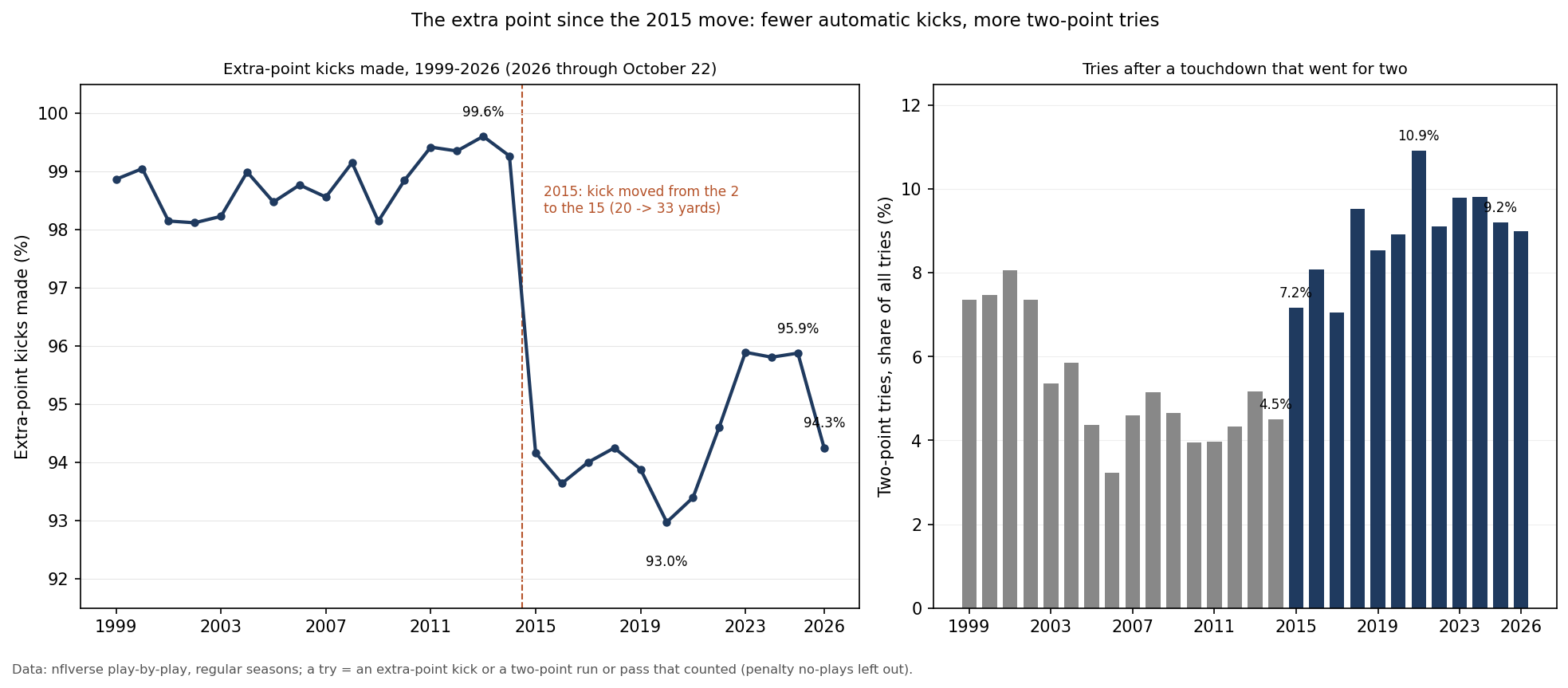
How Often Kickers Miss
| Season | Kicks | Good | Missed | Blocked | Made |
|---|---|---|---|---|---|
| 1999 | 1,059 | 1,047 | 7 | 5 | 98.9% |
| 2005 | 1,116 | 1,099 | 9 | 6 | 98.5% |
| 2010 | 1,217 | 1,203 | 8 | 3 | 98.8% |
| 2013 | 1,267 | 1,262 | 1 | 4 | 99.6% |
| 2014 | 1,231 | 1,222 | 2 | 6 | 99.3% |
| 2015 | 1,217 | 1,146 | 59 | 12 | 94.2% |
| 2018 | 1,235 | 1,164 | 67 | 4 | 94.3% |
| 2020 | 1,338 | 1,244 | 81 | 13 | 93.0% |
| 2023 | 1,169 | 1,121 | 41 | 7 | 95.9% |
| 2025 | 1,262 | 1,210 | 40 | 12 | 95.9% |
| 2026 (through Oct. 22) | 435 | 410 | 22 | 3 | 94.3% |
Moving the kick back 13 yards turned a near-certain point into an ordinary kick. Misses went from 13.6 a season to 68.5: there were 43 misses in 6,159 kicks from 2010 to 2014 (99.3%). In 2013 kickers missed 5 all season, 4 of them blocked. In 2015 they missed 71. The rate stayed below 95% for the next eight seasons, and the low was 2020 at 93.0%. It then climbed to 95.9%, 95.8% and 95.9% in 2023, 2024 and 2025, higher than any season from 2015 to 2022. Through October 22, 2026 kickers have made 410 of 435 (94.3%), 25 misses in 94 games.
A note on counting: the special teams page counts 1,268 extra-point plays in 2025, which includes 6 kicks wiped out by penalties and kicked again; this page counts the 1,262 that stood. Those 2025 seasons had 1,395 touchdowns: 1,262 were followed by a kick, 128 by a two-point try and 5 by no try.
The Distance, and the Weather
13,243 of the 13,445 tries from 2015 to 2025 were 33 yards. The other 202 came from other spots: 112 were 38 yards and 39 were 48 yards, 17 were 43 yards and 34 were shorter than 33. Kicks from 33 yards went in 94.5% of the time, kicks from other distances 84.7%. Field-goal tries of 32 to 34 yards in the same seasons were made 94.0% of the time (966 tries), so a modern extra point is about as hard as a field goal from the same spot. For field goals at every distance, see the field goal distance page.
| Extra-point kicks, 2015-2025 | Kicks | Made |
|---|---|---|
| Dome or closed roof | 3,976 | 95.4% |
| Outdoors | 9,222 | 94.0% |
| Outdoors, 32°F or colder | 474 | 92.8% |
| Outdoors, wind over 15 mph | 642 | 91.7% |
Conditions matter, but less than the 2015 move did. Indoors, kickers made 95.4%; outdoors, 94.0%; at 32°F or colder the rate fell to 92.8% and in wind over 15 mph to 91.7%. Even the best of these, 95.4% indoors, is well below the 98.8% kickers made from the old spot.
Kick or Go for Two
| Season | Two-point tries | Share of all tries | Converted |
|---|---|---|---|
| 2014 | 58 | 4.5% | 48.3% |
| 2015 | 94 | 7.2% | 47.9% |
| 2021 | 154 | 10.9% | 48.7% |
| 2025 | 128 | 9.2% | 46.1% |
The longer kick pushed teams toward two-point tries. Every season from 2003 to 2014 was under 6% (the low was 3.2% in 2006); every season since 2015 has been 7.0% or more. In 2025 teams converted 59 of 128 two-point tries (46.1%). From 2015 to 2025 two-point tries succeeded 47.7% of the time (631 of 1,322), against 46.9% from 1999 to 2014, so the two-point play did not get easier; the kick got harder.
On average the two options are close: 0.96 points per try in 2025 for the kick and 0.92 for the two-point try, and 0.94 and 0.95 over 2015-2025. With the averages that close, the score and the time left matter more, which is the subject of the two-point conversion page.
When the Defense Scores
Defenses have scored 15 times on returns since 2015, 9 after a blocked kick and 6 on two-point tries, the first on December 6, 2015, when New Orleans returned a blocked Carolina kick. That first return in the play-by-play matches the date and teams Wikipedia gives for the first defensive two-point score in NFL history. There were 2 in 2025 and none so far in 2026.
The rulebook also allows a one-point safety on a try. None of the 31,000-plus tries in the play-by-play since 1999 ended in a one-point safety.
What This Page Does Not Show
- Individual kickers. No kicker tried more than 56 extra points in 2025, too few to rank kickers on a 95% play, so no kicker is ranked here.
- Postseason games. Every figure is from the regular season.
- Before 1999. The play-by-play begins in 1999.
- Why kickers improved after 2022. The rise to 95.9% is measured; this page does not claim a cause.
Method and Sources
kick try      = a play-by-play row flagged as an extra-point attempt that stood (penalty no-plays left out)
made          = result "good"; missed = "failed"; blocked = "blocked"; before 2015 also "aborted" (bad snap or hold)
two-point try = a play flagged as a two-point attempt; converted = result "success"
share         = two-point tries / (kick tries + two-point tries), per regular season
points per try = make rate x 1 for the kick, conversion rate x 2 for the two-point try
distance      = nflverse kick distance; conditions = roof, temperature and wind as nflverse records them
2026          = the 94 games through Thursday, October 22
The script make_extra_point_chart.py checks the frozen play-by-play against its recorded hashes, rebuilds every figure on this page from it, cross-checks the 2025 count against the special teams freeze of October 23, draws the exhibit and asserts each number, including every rule against saved copies of the sources.
Sources: nflverse play-by-play releases for 1999-2026 (pulled 8:20 pm ET on October 25, 2026; 2026 rows limited to games through October 22). Rules, read October 25, 2026: the 2026 NFL Rulebook, Rule 11, Sections 1 and 3; NFL Football Operations, terms glossary; Wikipedia, Conversion (gridiron football) and Safety (gridiron football score); NFL.com, NFL moves extra point to 15-yard line for 2015 season.
Further reading
- Two-Point Conversion Decisions: when to go for two
- Field Goal Distance: how far kicks are and how often they go in
- What Is Special Teams: the kicking units and their share of points
- How Much Is a Field Goal: points for every score in football
- Weather and Scoring: what cold and wind do to games
Your team
Kept in this browser only.
Pick the playoffs
Pick the games left and see both conferences’ seeds under the NFL’s tie-breakers.
Go deeper
Want the code behind these metrics? Work through the 43-chapter NFL analytics tutorial.
Browse tutorials Free tools