How does a tie work in the NFL?
A regular-season NFL game ends in a tie when the score is still level after one 10-minute overtime period. Since 2025 both teams get the chance to have the ball in that period; after that, the next score wins, and if nobody scores before the clock runs out the game is a tie. Playoff games cannot end in a tie: they keep playing 15-minute periods. A tie counts as half a win and half a loss in the standings. There have been 16 ties since 1999, the latest the Giants and Washington, 27-27 on October 11, 2026. Five of the 15 ties from 2002 to 2025 decided a playoff place.
Related: how often games go to overtime · NFL tiebreakers · wins to make the playoffs
Figures from the nflverse game log and play-by-play, every regular-season game since 1999 and the 106 games of 2026 through Sunday, October 25, read October 26, 2026.
The Overtime Rules
The rules are in the 2026 NFL Rulebook (Rule 16), and Wikipedia's articles on overtime and on NFL tied games describe them the same way.
- Regular season. If the score is tied after four quarters, there is a coin toss and one 10-minute overtime period. Both teams must have the opportunity to possess the ball once, unless the team that kicks off scores a safety on the first possession. Once both have had it, the team ahead wins; if the score is still level, the next score wins.
- When it is a tie. There is only one period. If the score is level when the 10 minutes run out, even if the second team's possession has not ended, the game is a tie.
- Postseason. Overtime periods are 15 minutes and they keep coming until someone wins. No postseason game since 1999 has been tied; 28 went to overtime.
The format has changed four times. Regular-season overtime began in 1974, which is why ties went from common to rare. From 2012, a field goal on the first possession no longer ended the game; in 2017 the period was cut from 15 minutes to 10; and in 2025 the regular season adopted the guarantee that both teams get the ball.
How a Tie Counts in the Standings
A tie counts as half a win and half a loss for both teams, the rule in the NFL's tie-breaking procedures, and division titles and playoff places are decided by won-lost-tied percentage, not by the number of wins. Ties have counted this way since 1972; before that they were left out of the percentage altogether.
won-lost-tied percentage = (wins + 0.5 x ties) / gamesSo a 9-7-1 team (.559) ranks ahead of 9-8 (.529) and behind 10-7 (.588):
| Record | Won-lost-tied percentage |
|---|---|
| 10-7 | .588 |
| 9-7-1 | .559 |
| 9-8 | .529 |
That half game is often what separates teams in the race. The order among teams with the same percentage is settled by the tiebreakers, which work from the same percentage.
The Exhibit
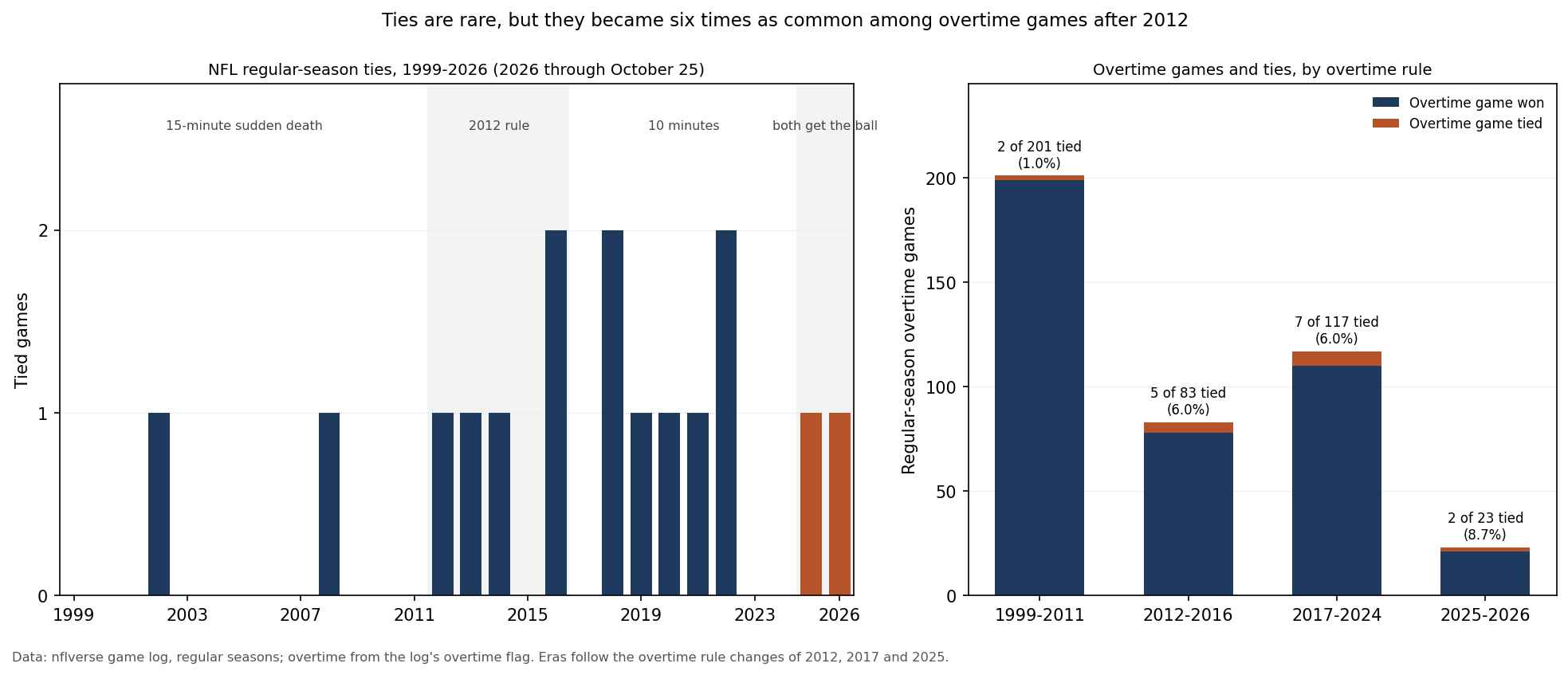
How Often Games End Tied
| Overtime rule | Games | Overtime games | Ties | Share of overtime games tied |
|---|---|---|---|---|
| 1999-2011 (15 minutes, sudden death) | 3,304 | 201 | 2 | 1.0% |
| 2012-2016 (a first-possession field goal no longer ends it) | 1,280 | 83 | 5 | 6.0% |
| 2017-2024 (10 minutes) | 2,111 | 117 | 7 | 6.0% |
| 2025-2026 (both teams get the ball; 2026 through Oct. 25) | 378 | 23 | 2 | 8.7% |
About one game in 17 goes to overtime, and only a small share of those end level. 1.0% of overtime games ended tied from 1999 to 2011, when a field goal on the first possession could end the game. The share rose to 6.0% from 2012 to 2016, after that changed, stayed at 6.0% again from 2017 to 2024 with the shorter period, and has been 8.7% since 2025 (2 of 23). In all, 14 of the 223 overtime games since 2012 (6.3%) have ended tied. The counts are small, so the exact shares are rough, but the jump came with the 2012 rule. Wikipedia's list of tied games counts 118 overtime games for 2017-2024; the game log used here flags 117. The overtime page shows how often games reach overtime and who wins there.
No season since 1999 has had more than two ties: 2016, 2018 and 2022 had two, and 15 of the 28 seasons from 1999 to 2026 had none. The 16 ties run from 6-6 (Seattle at Arizona, 2016) to 40-40 (Green Bay at Dallas, 2025).
What Ties Have Decided
To see what a half game is worth, each tie from 2002 to 2025 was replayed twice in the standings: once as a one-point win for each team, with every other result unchanged and the field rebuilt with the NFL's tiebreakers. (The rebuilt fields match the real playoff teams in every one of those seasons.) In five of the 15, a win by one side would have changed who made the playoffs:
- In 2008, Philadelphia finished 9-6-1 and made the playoffs; a Cincinnati win would have put 9-7 Tampa Bay in instead.
- In 2018, Pittsburgh finished 9-6-1, half a game behind 10-6 Baltimore in the AFC North, after a 21-21 tie in week 1; a Pittsburgh win in Cleveland would have given Pittsburgh the division, sent Baltimore to a wild card and left 10-6 Indianapolis out.
- Minnesota tied at Green Bay the next week and finished 8-7-1; a win would have put Minnesota in ahead of 9-7 Philadelphia.
- In 2022, the Giants finished 9-7-1 and took a wild card; a Washington win in that game would have put Washington and Detroit in and left the Giants and Seattle out.
- In 2025, Green Bay finished 9-7-1 as the NFC's seventh seed; a Dallas win in the 40-40 game would have put 9-8 Minnesota in instead.
In 2002 and 2016 a tie changed only the seeding, and the other eight changed nothing in the field. In three of the five, the tie got a team in; in two, Pittsburgh and Minnesota in 2018, it kept one out. How many wins it usually takes is on the wins to make the playoffs page.
What Happens in a Tied Overtime
Eight of the 11 ties since 2016 had no score in overtime, and in the other three each team kicked a field goal. Missed kicks run through them: eight had at least one missed field goal in overtime, 11 misses in all. In 40-40 Green Bay at Dallas in 2025, Green Bay kicked the tying field goal with 1 second left. Under the 2025 rule the second team always gets its chance, and all 23 overtime games under the 2025 rule have seen both teams with the ball.
2026 has one tie so far: the Giants at Washington on October 11, four overtime drives, one missed field goal, no points. Through Sunday, October 25, the Giants are 4-2-1 (.643) and Washington 1-4-1 (.250), and each carries that half win into the rest of the season.
What This Page Does Not Show
- A replay is not a prediction. Turning a tie into a win leaves every other game as it was. In a real season a different result could change later games, rest and motivation.
- Small samples. There are 16 ties in 28 seasons, so shares by era rest on a handful of games.
- Before 1999. The data used here starts in 1999; the rule history comes from the rulebook and Wikipedia.
- Other leagues. College and high school overtime work differently; this page is about the NFL.
Method and Sources
tie           = a regular-season game with equal final scores (every one went to overtime)
eras          = 1999-2011, 2012-2016, 2017-2024, 2025-2026, from the game log's overtime flag
standings     = (wins + 0.5 x ties) / games
what it decided = the season's playoff field rebuilt with the NFL tiebreakers (standings_tiebreak.py), then rebuilt
                with the tie as a one-point win for each side, every other result unchanged; 2002-2025
overtime play = drives in the fifth quarter of the 11 ties since 2016, nflverse play-by-play
The script make_ties_chart.py checks the frozen files against their recorded hashes, lists every tie, counts overtime games by era, rebuilds each affected season's playoff field and checks it against the real postseason games, replays each tie both ways, reads the overtime drives, then draws the exhibit and asserts each number on this page, including the rules against saved copies of the sources.
Sources: the nflverse game log and play-by-play releases (pulled 12:38 am ET on October 26, 2026; 2026 limited to games through October 25). Rules, read October 26, 2026: the 2026 NFL Rulebook, Rule 16; NFL.com, NFL tiebreaking procedures; Wikipedia, Overtime (sports), List of NFL tied games and Winning percentage.
Further reading
- Overtime: how often NFL games go to overtime
- NFL Tiebreakers Explained: division and wild-card rules
- How Many Wins to Make the Playoffs: 2002-2025
- One-Score Games: how many NFL games are decided by one score
- Down and Distance: what 3rd and 12 means
Your team
Kept in this browser only.
Pick the playoffs
Pick the games left and see both conferences’ seeds under the NFL’s tie-breakers.
Go deeper
Want the code behind these metrics? Work through the 43-chapter NFL analytics tutorial.
Browse tutorials Free tools