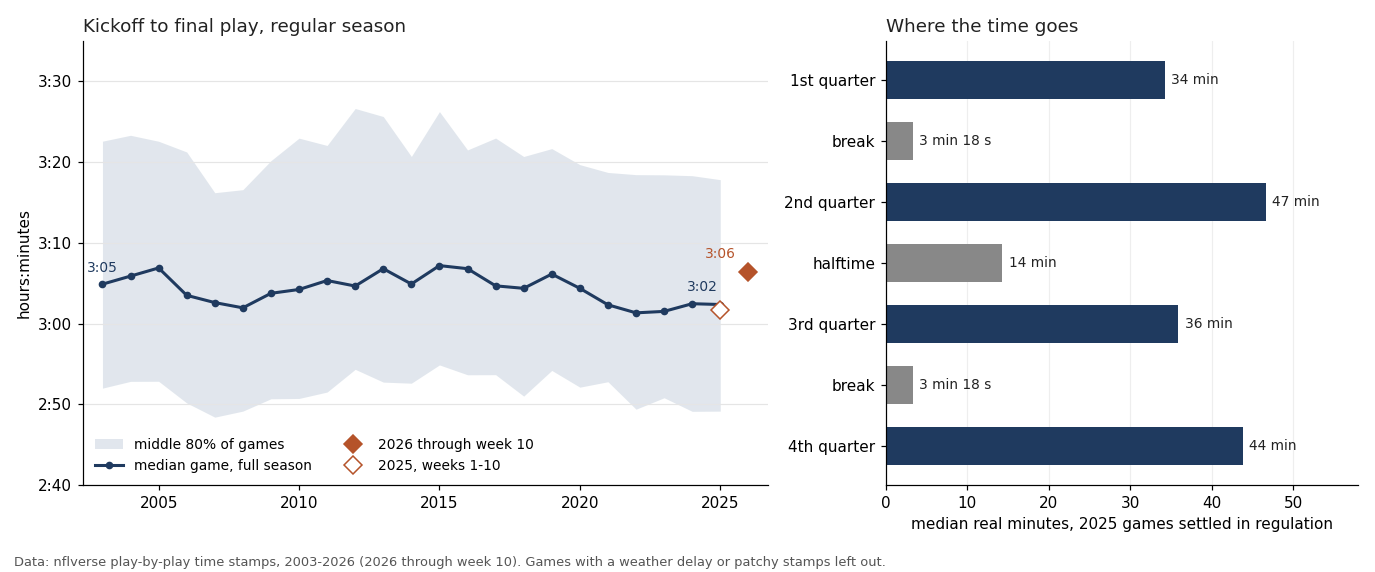
On paper an NFL game lasts 60 minutes: the league’s rulebook divides it into four 15-minute quarters. In real time it takes about three hours. The play-by-play stamps the time of day on every play, so the length can be measured game by game, from the opening kickoff to the end of the final play. In 2025 the median regular-season game took 3 hours 2 minutes, and the middle 80% of games ran from 2 hours 49 minutes to 3 hours 18 minutes. Over 5,726 measured games from 2003 to 2025 the median was 3 hours 4 minutes, and no season’s median strayed far from three hours: the shortest was 2022 at 3 hours 1 minute, the longest 2015 at 3 hours 7 minutes. The 2026 games are running longer so far, a median of 3 hours 6 minutes through week 10.
Related: how many plays are in an NFL game · time of possession · overtime
The Exhibit
Why 60 Minutes Takes Three Hours
The game clock runs only part of the time: it stops many times in a game, and between plays the offense has up to 40 seconds to snap the ball. Measured in real time, a 2025 game settled in regulation spent a median of 34 minutes on its first quarter, 47 on the second, 36 on the third and 44 on the fourth. The second and fourth quarters, the two that end a half, run about ten minutes longer than the first and third.
The breaks are short by comparison. The rulebook asks for at least two minutes between the first and second quarters and between the third and fourth; in 2025 the median break was 3 minutes 18 seconds and 3 minutes 18 seconds. Halftime has its own rule, 13 minutes, and the measured halftime (end of the last second-quarter play to the second-half kickoff) had a median of 14 minutes 15 seconds in 2025, with the middle 80% between 13 minutes 49 seconds and 15 minutes 6 seconds. Not one of the 270 measured games had a halftime shorter than 13 minutes; the measured gap runs from the end of the last play to the kickoff itself, so it takes in the moments on either side of the official 13 minutes. The Super Bowl is the exception: its halftime show stretches the break to a median of 32 minutes 32 seconds across the 22 measured Super Bowls since 2003 (the shortest 30 minutes, the longest 38), and the whole game to 3 hours 35 minutes.
Game Length by Season, 2003-2026
Season medians have stayed within 6 minutes of each other for 23 years. They drifted up to 3:07 in 2015 and have sat lower since the 17-game schedule arrived in 2021, between 3:01 and 3:02. Overtime games are the long tail: in 2022-2025 a game that went to overtime took a median 24 minutes longer than one settled in regulation.
| Season | Games measured | Median game | Middle 80% | Overtime games | Median overtime game | Median halftime (min) |
|---|---|---|---|---|---|---|
| 2026 (through week 10) | 149 | 3:06 | 2:53 to 3:24 | 12 | 3:32 | 14.3 |
| 2025 | 270 | 3:02 | 2:49 to 3:18 | 14 | 3:29 | 14.3 |
| 2024 | 271 | 3:02 | 2:49 to 3:18 | 16 | 3:20 | 14.2 |
| 2023 | 271 | 3:02 | 2:51 to 3:18 | 13 | 3:26 | 14.1 |
| 2022 | 271 | 3:01 | 2:49 to 3:18 | 20 | 3:28 | 14.1 |
| 2021 | 270 | 3:02 | 2:53 to 3:19 | 21 | 3:30 | 14.1 |
| 2020 | 254 | 3:04 | 2:52 to 3:20 | 10 | 3:23 | 14.1 |
| 2019 | 254 | 3:06 | 2:54 to 3:22 | 9 | 3:27 | 14.1 |
| 2018 | 255 | 3:04 | 2:51 to 3:21 | 15 | 3:35 | 14.1 |
| 2017 | 254 | 3:05 | 2:54 to 3:23 | 14 | 3:19 | 14.0 |
| 2016 | 253 | 3:07 | 2:54 to 3:22 | 13 | 3:32 | 14.2 |
| 2015 | 254 | 3:07 | 2:55 to 3:26 | 21 | 3:25 | 14.1 |
| 2014 | 249 | 3:05 | 2:53 to 3:21 | 11 | 3:18 | 14.1 |
| 2013 | 240 | 3:07 | 2:53 to 3:26 | 14 | 3:27 | 14.2 |
| 2012 | 237 | 3:05 | 2:54 to 3:27 | 21 | 3:35 | 14.3 |
| 2011 | 241 | 3:05 | 2:52 to 3:22 | 12 | 3:24 | 14.2 |
| 2010 | 244 | 3:04 | 2:51 to 3:23 | 18 | 3:24 | 14.1 |
| 2009 | 235 | 3:04 | 2:51 to 3:20 | 12 | 3:17 | 14.2 |
| 2008 | 238 | 3:02 | 2:49 to 3:17 | 14 | 3:23 | 14.3 |
| 2007 | 229 | 3:03 | 2:48 to 3:16 | 11 | 3:16 | 14.3 |
| 2006 | 242 | 3:04 | 2:50 to 3:21 | 11 | 3:22 | 14.3 |
| 2005 | 232 | 3:07 | 2:53 to 3:23 | 14 | 3:23 | 14.4 |
| 2004 | 233 | 3:06 | 2:53 to 3:23 | 11 | 3:36 | 14.4 |
| 2003 | 229 | 3:05 | 2:52 to 3:23 | 17 | 3:28 | 14.3 |
Times are hours:minutes, regular season only. A game is measured when at least 90% of its plays carry a time stamp and no weather delay or other pause of more than 30 minutes interrupted it; that leaves out 25 delayed games since 2003 and, in the older seasons, up to a few dozen games a year with patchy stamps (every game has full stamps from 2017 on). Play-by-play files before 2003 carry no stamps.
What Makes a Game Longer
Across the 1,083 measured regular-season games of 2022-2025, a simple model of game length on what happened in each game explains 78% of the differences between games. Holding the rest equal, each extra offensive play went with about 17 seconds more, each play with a penalty flag about 44 seconds, each incomplete pass about 39 seconds (the clock stops), each timeout about 1 minute 4 seconds, each touchdown about 1 minute 24 seconds (the try and the kickoff follow) and each replay review or coach’s challenge about 1 minute 43 seconds; reaching overtime added about 11 minutes beyond the extra plays it brings. These are associations measured on real games, not a stopwatch on each event: a touchdown, for instance, may also bring a TV break, which the data does not mark.
The kickoff window barely matters. Among games settled in regulation in 2022-2025:
| Kickoff window (ET) | Games | Median game |
|---|---|---|
| Sunday 1 p.m. | 498 | 3:01 |
| Sunday late afternoon | 253 | 3:01 |
| Sunday night | 65 | 3:03 |
| Monday night | 73 | 3:00 |
| Thursday night | 63 | 3:02 |
The longest and shortest medians differ by about 2 minutes. Playoff games outside the Super Bowl ran a median 3 hours 3 minutes in 2022-2025 (48 games), about the same as the regular season’s 3 hours 2 minutes, with a median halftime of 14 minutes 20 seconds. The shortest regular-season game measured since 2003 was Las Vegas at Philadelphia on December 14, 2025, 2 hours 31 minutes for a 31-0 Philadelphia win. The longest settled in regulation without a delay was Arizona at Seattle on November 15, 2015, 3 hours 53 minutes (39-32 Arizona); the longest overtime game was Cleveland at Oakland on September 30, 2018, 4 hours 4 minutes (45-42 Oakland).
Why 2026 Is Running Longer
Through week 10 the median 2026 game has taken 3 hours 6 minutes (149 measured games), against 3 hours 2 minutes over the same ten weeks of 2025 (147 games). On averages, 2026 games are 4.1 minutes longer. The model above puts 2.4 minutes of that on what happened in the games: more overtime (12 of 149 games, 8.1%, against 5 of 147, 3.4%, in the same weeks of 2025) and a few more offensive plays (129.1 a game for both teams against 127.0). The other 1.7 minutes are longer gaps between plays that the play-by-play does not explain. Ten weeks is a real sample but not a season; the full-season figure is the one to judge.
The Rules Behind the Clock
- Game length: 60 minutes, four quarters of 15 minutes (2026 NFL Rulebook, Rule 4, Section 1, Article 1).
- Breaks: at least two minutes between the first and second quarters and between the third and fourth (Article 2); halftime 13 minutes (Article 3).
- Overtime, regular season: after an intermission of no more than three minutes, one 10-minute period; both teams get a chance to have the ball unless the kicking team scores a safety on the first possession; if it is still tied after the 10 minutes, the game ends in a tie (Rule 16, Article 3).
- Overtime, playoffs: 15-minute periods, as many as it takes, with a two-minute break between periods (Rule 16, Article 4).
- Between plays: a 40-second play clock (Rule 4).
From the league’s 2026 NFL Rulebook (NFL Football Operations; the PDF linked there), read November 19, 2026. How often games reach overtime, and how the 10-minute rule changed ties, is on the overtime page.
What This Page Does Not Show
- Broadcast length. The clock here starts at the opening kickoff; a broadcast’s pregame is not counted.
- Delayed games. Games stopped by weather or another long pause are left out of every median, so the figures describe an uninterrupted game.
- Causes. The model measures which events go with longer games; it does not time TV breaks, which the data does not record.
- Seasons before 2003. The play-by-play files for 1999-2002 carry no time stamps.
Method and Sources
- game length = the first time-stamped play (the opening kickoff) to the end of the last play; a stamp more than six hours from its game’s median stamp (a wrong calendar day, found in the 2013-2016 files) or more than ten minutes from the plays around it is dropped first
- measured game = at least 90% of plays stamped, no weather suspension in the play text, no pause over 30 minutes between two plays outside halftime: 5,726 regular-season games in 2003-2025 and 149 of the 150 in 2026
- quarter = its first stamped play to the end of its last; break = end of one quarter’s last play to the next quarter’s first stamp; halftime the same across the half
- kickoff window = the scheduled kickoff (ET) and weekday in the nflverse game log; international morning games and holiday afternoons left out
- model = least squares of game length on offensive plays, plays with a penalty flag, incomplete passes, timeouts, touchdowns, replay reviews and challenges, and an overtime flag, 2022-2025 regular season
Our chart script checks the frozen files against their recorded hashes, matches the 2025 figures on the plays page, measures every game, draws the exhibit and asserts every number on this page.
Sources: nflverse play-by-play releases, every season from 1999 to 2026, pulled November 19, 2026 (2026 through week 10, the Monday game of November 16), and the nflverse game log for kickoff times and scores; rules from the 2026 NFL Rulebook.
Further reading
- How Many Plays Are in an NFL Game?: what those three hours are made of, play by play
- Time of Possession: how the 60 game minutes split between the offenses
- Overtime: how often games go long, and how the 10-minute rule changed ties
- PROE and Game Script: why a team that leads runs the ball and the clock
Your team
Kept in this browser only.
Pick the playoffs
Pick the games left and see both conferences’ seeds under the NFL’s tie-breakers.
Go deeper
Want the code behind these metrics? Work through the 43-chapter NFL analytics tutorial.
Browse tutorials Free tools